-
Biography
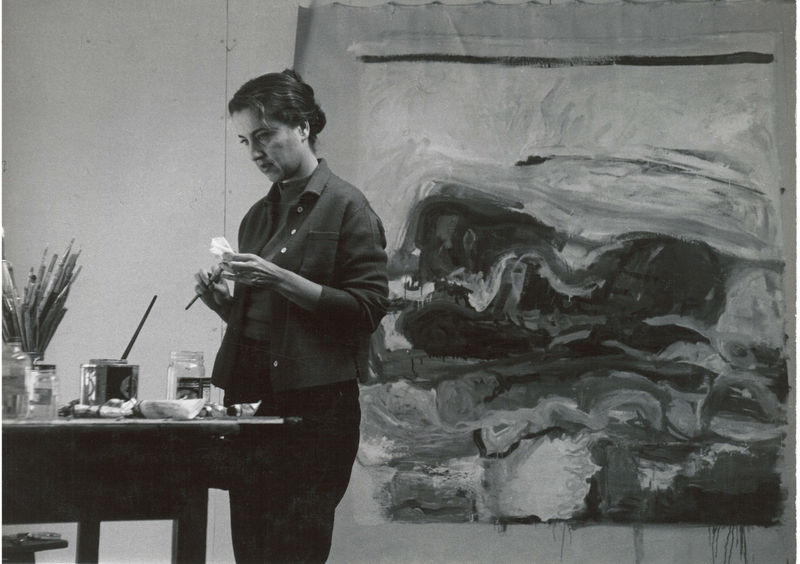
 Photo: John Jonas Gruen
"Freilicher’s paintings gradually summon fugitive emotions that are beyond words. Foremost for me is a slightly melancholy but secretly smiling spirit of acceptance, conveyed with a casual formality that honors painting’s trusty conventions. I am reminded of the title of an O’Hara poem: 'In Memory of My Feelings.'" —Peter Schjeldahl
Jane Freilicher’s light-swept canvases are instantly recognizable. A key member of the New York School in the 1950s and one of the foremost representational painters of postwar America, Freilicher is celebrated for her uniquely fluent and personal approach to painting.
Born in Brooklyn, New York, in 1924, Freilicher took an early interest in art and French literature. She studied both subjects at Brooklyn College (1938–42) and later received her M.A. from Columbia University Teachers College (1948–49). She went on to study with the influential teacher and painter Hans Hofmann in New York and Provincetown, Massachusetts. After a brief period working in abstraction—an approach she would return to intermittently—Freilicher embraced what she described as the “struggle” of representational painting, which would preoccupy her for more than six decades.
Freilicher is best known for her framing of everyday objects within the casual order, or disorder, of her studios in lower Manhattan and on Long Island. Often positioning the viewer at the threshold between interior and exterior, her paintings are drawn from life yet rendered into a gentle fiction. They illuminate an interior world defined by steadfast attention to intimate domestic subjects—flowers, window ledges, and the shifting New York skyline. “Every flower has its own cosmology, its own relationship to the foliage, to the air around it,” she told an interviewer in 1998. At the artist’s memorial in 2014, Freilicher’s contemporary and friend Alex Katz shared, “No one painted flowers or their color the way Jane did.”
-
In the late 1940s, Freilicher met the poets John Ashbery and Frank O’Hara, whose friendships made an indelible mark on her life and work. Their intellectual and creative exchange led to numerous collaborations across film, theater, printmaking, and poetry. Freilicher was an important figure in the downtown arts scene that included painters Joan Mitchell, Grace Hartigan, Nell Blaine, and Helen Frankenthaler, and poets Kenneth Koch, James Schuyler, and Larry Rivers. Fairfield Porter’s 1956 ARTnews article “Jane Freilicher Paints a Picture” deepened their ongoing dialogue and brought her work to broader acclaim.
In 1952, Freilicher held her first solo exhibition at Tibor de Nagy Gallery, New York, and established a studio on the top floor of a tenement building on East Eleventh Street overlooking the Con Edison smokestacks. The vertical forms of those stacks became recurring motifs in her city views, most notably in Early New York Evening (1954), now in the collection of the Whitney Museum of American Art, New York.
Throughout her career, Freilicher painted landscapes, urban skylines, portraits, and domestic scenes with great affection for her subjects—though, by her own admission, she did not consciously distinguish between genres. “A combination of forms and color in nature will somehow ignite a kind of energy providing the occasion for a painting,” she once explained. In this, she drew inspiration from French Post-Impressionists such as Édouard Vuillard and Pierre Bonnard, whose explorations of light and color embraced a similarly intimate, subjective approach to representation. Freilicher’s affinities extended further, still – in the 1974, the text accompanying Freilicher’s inclusion in Wadsworth Atheneum’s pioneering MATRIX series described, “Her sensitivity to the way in which the artist’s original intentions and preconceived expectations can be instantly altered in response to the initial mark on a canvas suggests that she brings to the genres of landscape and still life a spontaneity and commonly associated with the legacy of abstract expressionism.”
-
Jane Freilicher, Summer Flowers, Urban Dusk, 1994
-
Installation Shots
Installation view, Jane Freilicher: Parts of a World, Kasmin, New York, NY, 2021
-
Works
-
Untitled, c. 1980
-
Amaryllis Against Blue, 1986
-
Untitled (Curtains), 1973
-
Reclining Nude, 1970s
-
Sunset, 1969-1988
-
Landscape with Ploughed Potato Field, 1966
-
Untitled (Still Life), 1953
-
1924-2014